Transformer Architecture in 2026 — SilentRecon Deep Dive
SilentRecon Deep Dive: Understanding Transformer Architecture in 2026

By SilentRecon — Advanced Reconnaissance & AI Systems Engineering
Transformers have become the backbone of modern AI — powering everything from large language models to cybersecurity anomaly detection. Yet despite their dominance, most explanations remain either too academic or too shallow.
This article breaks down transformer architecture the SilentRecon way: clear, technical, operational, and directly connected to real‑world engineering.
1. Why Transformers Matter in 2026
Transformers replaced RNNs and LSTMs because they solved the two biggest problems in deep learning:
Long‑range dependency failure
Slow sequential processing
Instead of processing tokens one by one, transformers process everything in parallel, using attention to decide what matters.
This shift unlocked:
massive scalability
faster training
deeper contextual understanding
multi‑modal reasoning
real‑time inference at scale
For cybersecurity, cloud automation, and OSINT workflows, transformers are now the default intelligence layer.
2. The Core Components of a Transformer
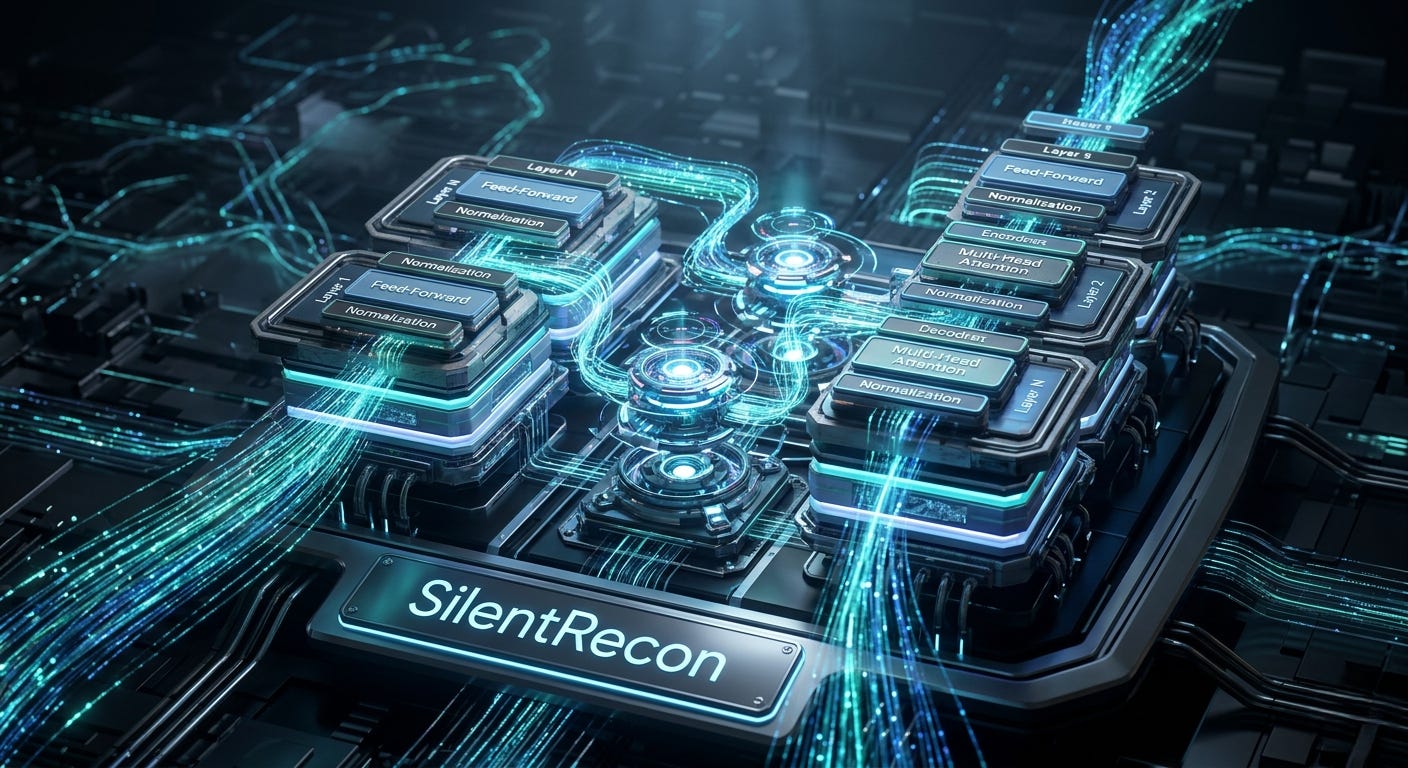
Below is the SilentRecon breakdown of each block you see in the uploaded image.
Multi‑Head Attention
The engine of the transformer.
It lets the model “look” at different parts of the input simultaneously.
Each head learns a different pattern:
syntax
semantics
relationships
dependencies
anomalies
This is why transformers outperform older architectures in reasoning and detection.
Feed‑Forward Networks
After attention extracts relationships, the feed‑forward layer transforms the representation.
Think of it as:
compression
expansion
nonlinear transformation
feature refinement
This is where the model learns abstract concepts.
Normalization
Keeps training stable by normalizing activations.
Without normalization:
gradients explode
training collapses
attention becomes unstable
SilentRecon uses normalization heavily in its internal audit models to stabilize long‑sequence analysis.
Encoder
Processes the input and builds a contextual representation.
Used for:
OSINT document analysis
log ingestion
threat intelligence
embeddings
vector search
Decoder
Generates output based on encoder context.
Used for:
text generation
report drafting
anomaly explanation
predictive modeling
3. How Data Flows Through the System
The uploaded image shows the exact flow:
Input tokens enter the encoder stack
Multi‑head attention extracts relationships
Feed‑forward layers transform the representation
Normalization stabilizes the output
Encoded context flows into the decoder
Decoder attention aligns with encoder output
Final output is generated
This pipeline is the foundation of modern AI systems — including SilentRecon’s internal
analysis engines.
4. Why SilentRecon Uses Transformer‑Based Intelligence
SilentRecon’s methodology relies on:
deep OSINT
structured reconnaissance
attack‑surface mapping
anomaly detection
risk scoring
senior‑level technical analysis
Transformers enhance these capabilities by providing:
✔ Contextual understanding
They can read long documents, logs, and datasets without losing context.
✔ Pattern detection
Attention layers highlight relationships humans often miss.
✔ Scalability
Parallel processing allows SilentRecon workflows to scale across large datasets.
✔ Explainability
Attention maps help justify findings in audit reports.
✔ Multi‑modal capability
Transformers can process text, images, logs, and structured data simultaneously.
SilentRecon integrates transformer‑based intelligence into its audit methodology to deliver high‑precision, high‑context, high‑credibility results.
5. Real‑World Applications (SilentRecon Use Cases)
Threat Intelligence Summarization
Transformers condense large threat reports into actionable insights.
Attack Surface Mapping
Attention layers detect hidden relationships between assets.
Log Anomaly Detection
Transformers outperform traditional statistical models in pattern deviation detection.
Reconnaissance Automation
SilentRecon uses transformer‑powered agents to automate OSINT flows.
Executive‑Level Reporting
Decoders generate clean, structured summaries for leadership.
6. The Future: Transformer 2.0 and Beyond
By 2026, we’re seeing:
Mixture‑of‑Experts (MoE)
Long‑context models (1M+ tokens)
Sparse attention
Hybrid symbolic‑neural systems
On‑device inference
SilentRecon is already experimenting with these architectures for:
autonomous recon
continuous monitoring
real‑time risk scoring
multi‑modal intelligence fusion
The next generation of transformers will be even more efficient, interpretable, and specialized.
7. Final Thoughts — The SilentRecon Advantage
Transformers are not just an AI architecture. They are the intelligence engine behind modern cybersecurity, OSINT, and cloud automation.
SilentRecon leverages transformer‑based systems to deliver:
deeper analysis
faster workflows
higher accuracy
stronger reporting
unmatched technical clarity
This is how SilentRecon stays ahead — by combining human expertise with cutting‑edge AI architecture.